
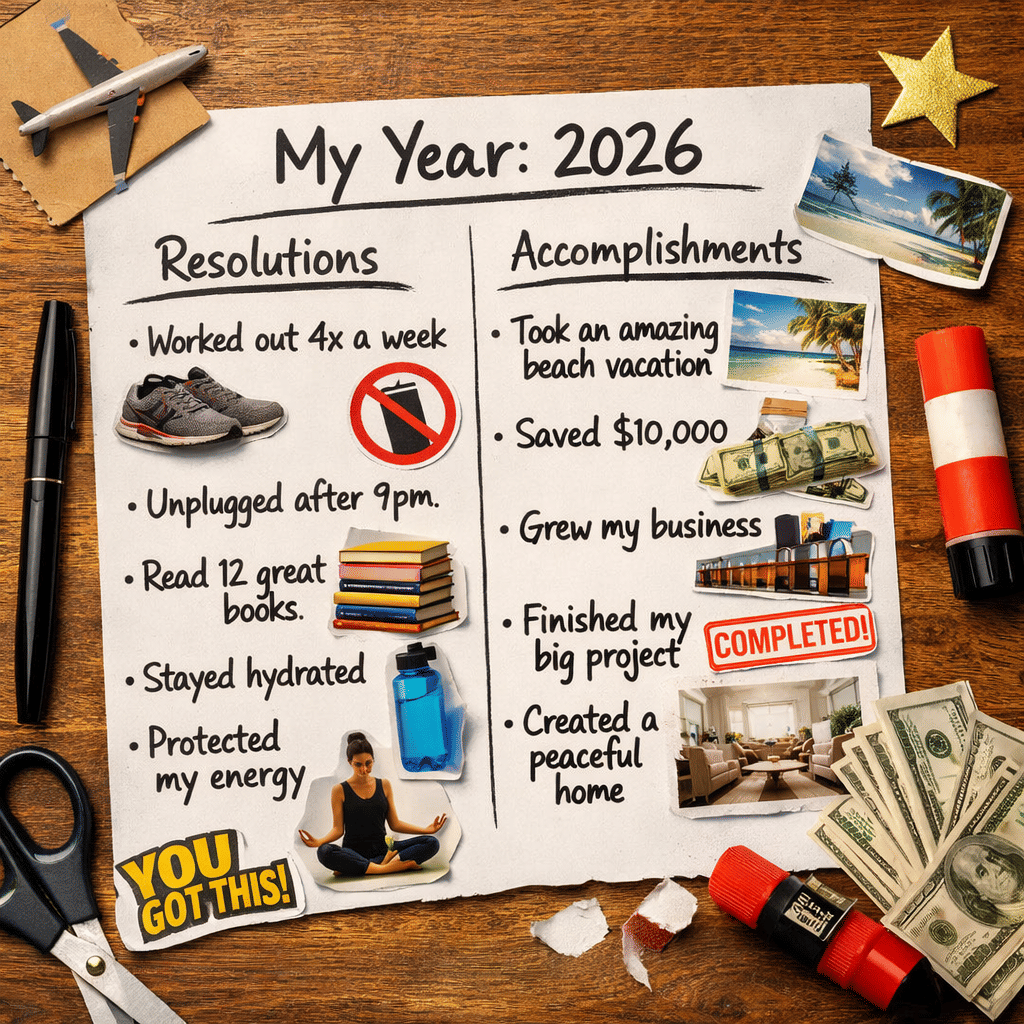
Every New Year, the internet turns into a giant goal factory. Apps. Trackers. Templates. “Top 10 habits of high performers.” And honestly? Half of it disappears by mid-January.
If you want something that sticks — something that’s simple, emotional, and weirdly powerful — do this instead:
Write your New Year’s goals by hand on paper.
And don’t just write a list… build a vision page.
It sounds almost too basic to matter. But that’s the point. The “basic” stuff is usually what works.
Why handwriting hits different
Handwriting slows you down. It forces you to actually think. It’s not copy/paste. It’s not vibes. It’s you committing to a direction with your own actual human hand.
Typing is clean. Handwriting is personal.
And personal goals need a personal method.
Step 1: Get one sheet of paper and a pen you like
Use printer paper, a legal pad, a notebook — whatever. The key is: one page that becomes your “year contract.”
If you want to level it up:
Use thicker paper
Add a header like “My Year: 2026”
Date it
Sign the bottom like you mean it
Step 2: Make two lists — not one
Most people write vague resolutions like:
“Get healthier”
“Save money”
“Travel more”
Cool… but your brain can’t grab onto fog.
Instead, split your page into two sections:
A) New Year’s Resolutions (daily/weekly habits)
These are the behaviors and routines that shape your year.
Examples:
Move my body 4x/week
Stop doomscrolling after 9pm
Read 12 books
Drink water like a responsible adult
Keep my energy protected (boundaries count)
B) End-of-Year Accomplishments (measurable outcomes)
These are the “by December 31” wins.
Examples:
Took two meaningful trips
Hit a savings goal
Built a calmer home life
Grew my business / started the side project
Finished the thing I’ve been procrastinating for three years
This gives you both the process and the prize.
Step 3: Cut out pictures of your goals and glue them onto the page
This part is sneaky powerful.
Go find images that represent what you want:
Print pictures from Google Images
Cut from magazines
Use old brochures, catalogs, even packaging
Or draw little icons if you don’t want to print
Then paste them next to each goal like a mini vision board built into your list.
Examples:
A photo of a calm beach next to “I took my restorative trip.”
A screenshot of a bank balance graph next to “I saved $____.”
A picture of a diploma/book cover next to “I finished my course/certification.”
A photo of a clean room next to “My home is organized and peaceful.”
Your brain loves images. It’s harder to ignore a goal when it has a physical picture staring at you.
Step 4: Write every goal as if it’s already done
This is the real sauce.
Instead of writing:
“I want to get in shape”
“I hope I travel”
“I’m going to be better with money”
Write it like you’re reporting back from the future:
“I’m proud that I stayed consistent with my workouts.”
“I took that trip and came back feeling like myself again.”
“I built a savings cushion and I feel secure.”
“I finished the project I kept postponing.”
“I protected my energy and stopped overcommitting.”
It’s not delusion — it’s direction.
You’re basically telling your mind:
“This is who we are now. Let’s act like it.”
Step 5: Put it somewhere you’ll actually see it
Don’t hide it in a notes app graveyard.
Put the page:
On your closet door
Inside your desk drawer (front and center)
In your journal (first page)
On your wall behind your monitor
Or folded into your wallet/bag
You don’t need to stare at it daily — but you should bump into it enough that it stays alive.
Step 6: Revisit it in one year (and don’t judge yourself)
Here’s the final step most people skip: the review.
On the same date next year, pull it out and read it like a letter you wrote to yourself.
Two important rules:
No shame. If you missed things, you didn’t “fail.” You collected data.
Celebrate what did happen. You’ll almost always realize you grew in ways you didn’t track.
Sometimes you don’t get everything you wrote down — but you become the kind of person who could.
And that’s the whole point.
The quiet magic of this ritual
This is not productivity porn. It’s not a hustle challenge.
It’s a grounding practice.
You’re making your goals tangible:
with paper,
with pictures,
with language that makes the future feel real.
And a year from now, you’ll have proof of what mattered to you… and how far you’ve come.
So grab a pen, make it messy, glue on the pictures, and write your wins like they already happened.
Then go live into the story you just wrote.